TL;DR: yes, but also, no.
Actors from across the Commonwealth are often lauded for their ability to shift chameleon-like across dialects. Let’s break down why this myth persists, some reasons why Commonwealth actors actually do have a cultural and linguistic advantage when it comes to accent work, and why every actor regardless of nationality can build a strong foundation of accent tools for their personal toolbox.
Just today, I had a friend ask me, “Do you think being Australian helps you with doing other accents?”
The short answer is, no.
Nationality has no impact on accent aptitude. Nationality doesn’t impact whether an actor has worked on close listening, and individual proficiency with phonetic mimicry.
The longer answer is, (a very qualified) yes.
I’ll expand on this answer more below! (For the sake of brevity —haha, this post took on a life of its own!— I will do my best to limit my discussion in this post mostly to British actors, but the same factors apply to other Commonwealth actors too, just in different contexts!)
expanding on The Myth
If you’re an actor, or just someone who enjoys films, you’ve probably heard someone say: “British actors are just better at accents”. There are certainly some incredible Commonwealth actors who perform believably across a range of accents. British actors with great American accents include: Hugh Laurie in House, Daniel Kaluuya in Get Out, Damian Lewis plays a very convincing American across Band of Brothers and Billions, and Idris Elba famously maintained an American accent for his audition for The Wire, fooling casting directors with its believability. South of the equator, many viewers don’t even realise Toni Collette is Australian as she flips seemingly effortlessly between British and American accents. Australian Jacob Elordi’s Northern English accent in Wuthering Heights was spectacular in its specificity. Sam Neill (beloved recently departed New Zealander) performed across American and Irish accents in his most famous roles in Jurassic Parkand Peaky Blinders. I loved both Aussie Sam Reid’s and Brit Jacob Anderson’s specific accent choices in Interview With A Vampire. The list of great examples could go on and on.
But let’s not discount the fabulous North American actors performing outside of their native dialect: Renee Zellweger in Bridget Jones’ Diary, Meryl Streep in (just about everything, but specifically) Sophie’s Choice, and Connor Storrie’s turn as a Russian hockey player in Heated Rivalrywas perhaps the single most impressive accent performance I have watched. Tatiana Maslany, a Canadian, flawlessly flips between characters with many different accents in Orphan Black. Stories of Americans fooling casting directors with their accent proficiency abound; Zach McGowan was cast in Black Sailsafter the casting director said they would not consider non-Commonwealth actors for the pirate period piece, Chloe Grace Moretz fooled Martin Scorsese (who also said he would not consider non-Brits) into believing she was British for her performance in Hugo.
The British Advantage
Reading this heading, you might be asking me, “Okay then, so is there a grain of truth to this myth?” And there are a few ways Brits could, perhaps, maybe have an advantage when it comes to learning an American accent. I’ll go over some social reasons first, and then dive into a sneaky phonetic advantage that Brits have over Americans!
familiarity
This cuts two ways: Commonwealth actors have more familiarity with a wider range of accents, and American casting directors are less familiar with Commonwealth accents.
Brits are more familiar with British regional accents, and perhaps also with some European accents due to geographic closeness. That’s it. If you live in the UK, you’re much more likely to run into speakers from all areas of the island, and if you’re in a metropolis like London, you’re just as likely to hear people speak in accents from all over the globe. The lived experience of hearing and having to work to understand a wide range of phonetic variety could be a factor that gives British actors a leg up when working on accents. However, this advantage is not limited to actors living in London: actors from any major international city are exposed to a large range of phonetic variety. So this alone doesn’t explain a UK-specific edge.
If Brits are interacting with American casting directors, they may also have the advantage that those casting directors are less familiar with how regional British accents and European accents should sound. This lack of familiarity could lead to casting directors being impressed by a less than spot-on performance.
In my own experience as a young Aussie actor in the States, I was first cast on British audiobooks by an American casting director who heard me speak in my Australian voice and thought I was English. It led to a (funny-in-hindsight) run-in in the lunch room, where she asked me, “Where in the UK are you from?” to which I replied: “Sydney!” I was not even attempting a British accent, and yet the casting director’s lack of familiarity between British and Australian accents led my non-British sound to be miscategorised; I’m sure this happens when non-American actors are deliberately affecting an accent as well.
Fame
If you’re in the States, you’re hearing the best non-American performers, and a mix of the worst-to-best American performers.
Trust me. As someone who’s lived in Australia and the UK, I’ve heard my fair share of very bad American accents on Antipodean and UK stages and television. By the time Commonwealth actors make it to a US TV or film role, they’ve likely had years of voice training and may have worked very intensively with a dialect coach to perfect that American sound. I know I did!
phonetics
As someone who has taught Brits how to sound American, and American how to sound British, there is a key vowel change that trips a lot of Americans up. When we talk about vowels across accents, we can describe the realisation and distribution of vowels using lexical sets (with much thanks to the work of linguist J.C Wells).
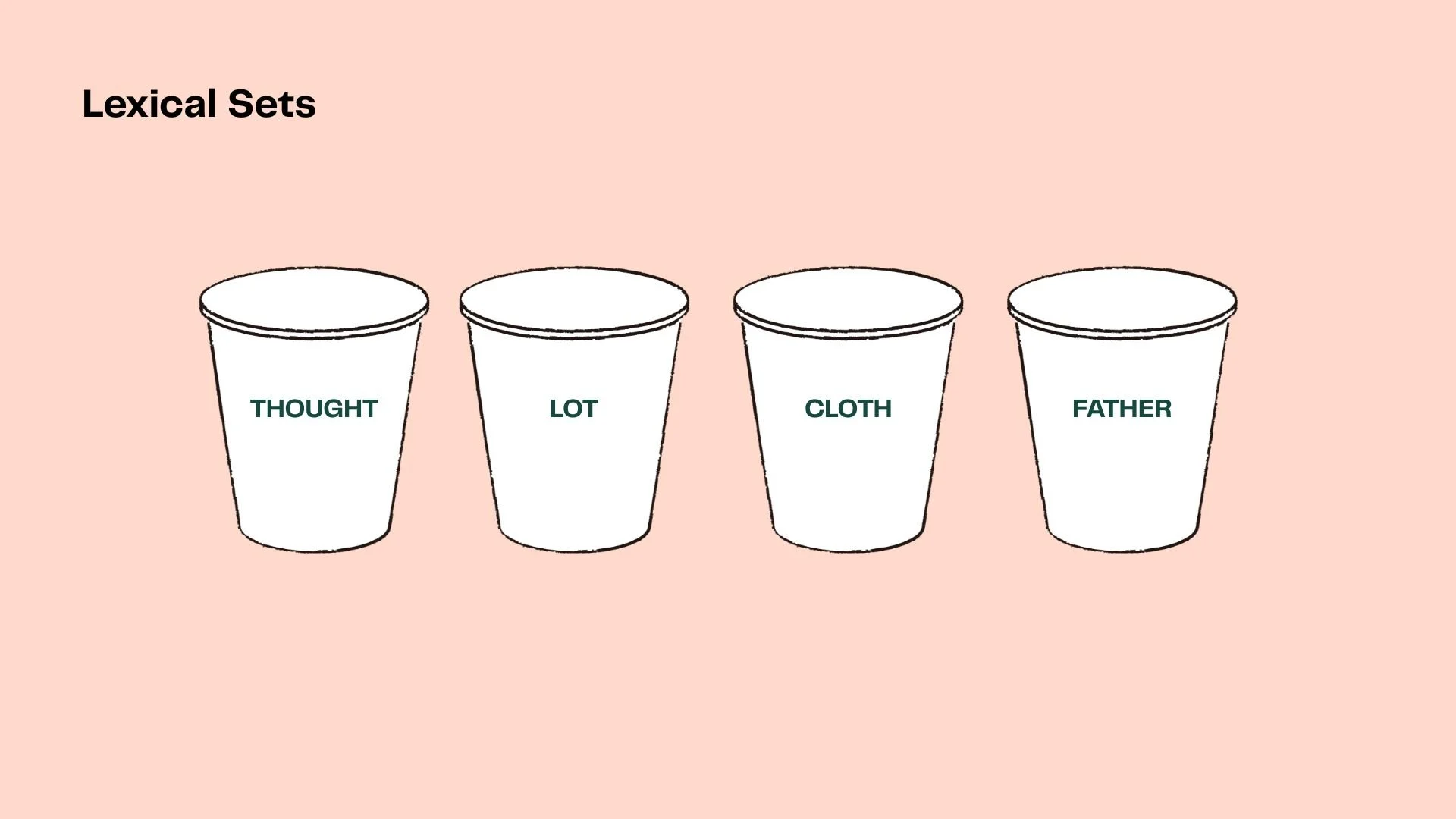
In Generican, the lexical sets of LOT, CLOTH, FATHER and THOUGHT are often collapsed into one “vowel bucket” and pronounced as exactly the same vowel, the open back rounded vowel [ɑː]. This collapsing of lexical sets into one bucket is known as a lexical set merger.

In Standard Southern British (also called British RP, or New Standard English Accent), THOUGHT, FATHER and CLOTH-LOT have three separate vowels. You can see in the image below that these vowels are sorted into different vowel buckets, the mergers THOUGHT-FORCE-NORTH [ɔː], LOT-CLOTH [ɒ] and FATHER-BATH-START [ɑː].
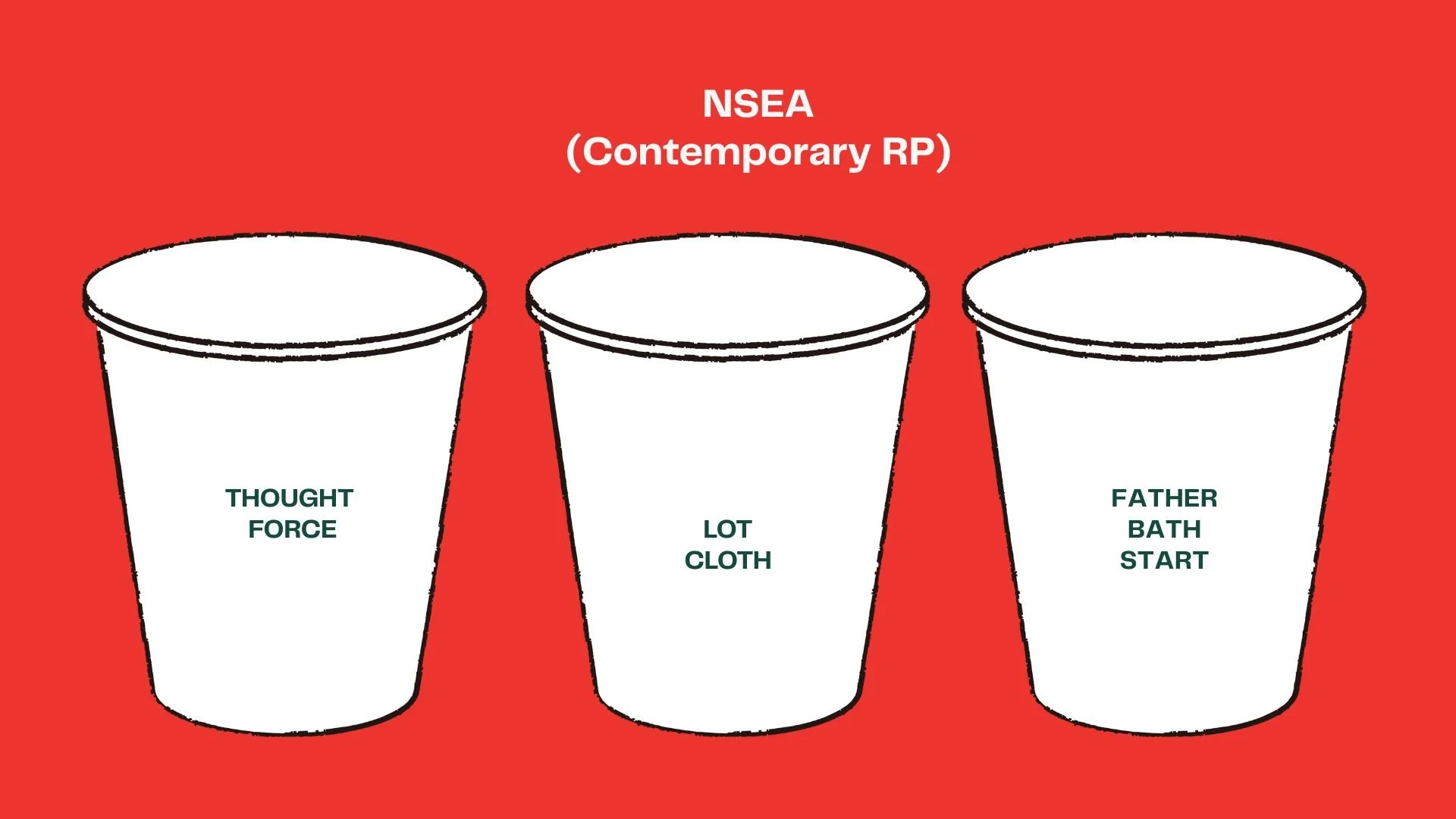
How is this a British advantage? It is much easier to collapse multiple vowels into one sound-bucket than it is to feel out the previously unknown borders of new sound buckets, and correctly assign new closely-realised vowels to their corresponding lexical sets. In an American accent, the vowels in a sentence like: “Not all people like the spa” are all the same vowel. In a British accent, there are three different vowels: “Not all people like the spa”. Just to add to the difficulty level, each of these vowels is realised very closely together in the mouth, but is distinctly different to Commonwealth ears.
So Americans are attempting to navigate both redrawing borders of these buckets, and a level of precision in creating these vowels which was previously not needed to create meaning in their own dialect. In the British accent the vowel change creates meaning: “not” and “naught” are not homonyms, neither are “palm” and “pom”.
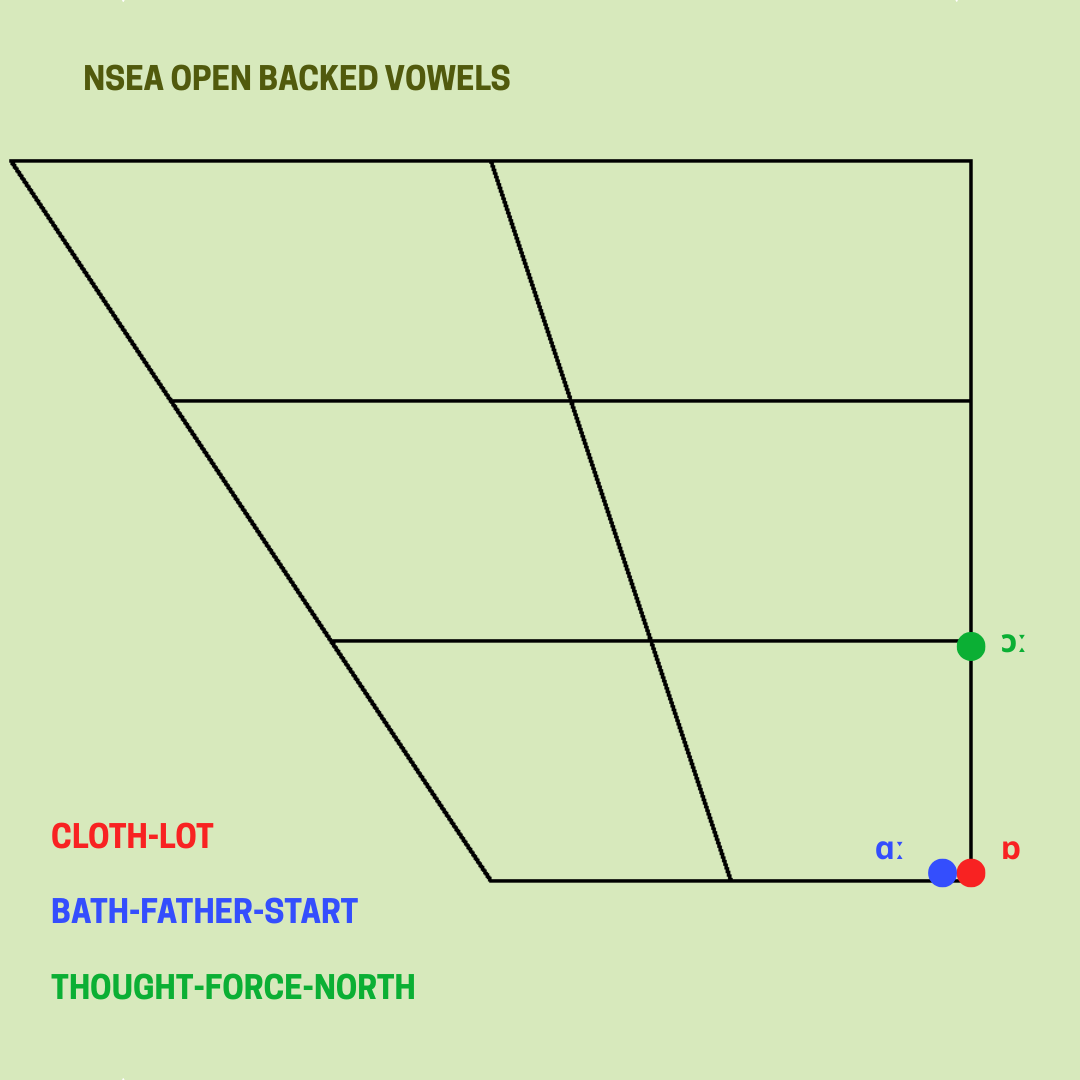
In this image of a vowel quadrilateral, you can see how close together the vowels for these lexical sets are. The CLOTH-LOT vowel is a rounded version of the BATH-FATHER-START vowel, which is differentiated only by being unrounded and a longer duration (those : marks indicate vowel length).
the british disadvantage
rhoticity (or, the pesky letter ‘R’)
When you think about the difference between British and American accents, your mind might immediately go to rhoticity (otherwise known as “R”-ishness.) Everyone pronounces /r/ when it occurs before a vowel (often at the beginning of a word or syllable) eg. red, ribbon, rot, rubbish, and also bridge, afraid, tree. But accents vary in how they treat /r/ before a consonant. American is a rhotic accent. This means Americans also pronounce an /r/ sound that occurs before a consonant, or at the end of a word eg. car, water, start, fork, curt, aboard, pearl. Forming this rhoticity pre-consonant can be very tricky for speakers coming from a non-rhotic accent. (Equally, not pronouncing the /r/ pre-consonant can be very tricky for speakers coming from a rhotic accent!)
As a dialect coach, I have observed that it is often more difficult for non-rhotic speakers to find the right level of tongue tension, duration, and lip rounding to create a believable American /r/. Commonwealth speakers often over-do the /r/, resulting in a slightly uncanny-valley sound, or slight Southern feeling to the accent. In fairness, Americans often struggle with the linking-R and interjected-R, which are key features of most non-rhotic accents… but I will save a discussion on that for another blog post!
economic necessity
There are many more roles out there that call for an American accent than for any other accent. While British accents may be the second most called-for, as the actor’s positionality becomes less featured in Hollywood, so too are they at an economic disadvantage. The push to learn a variety of accents and “pass” as different nationalities is absolutely essential for non-American actors. It is an economic necessity. Any actor from any non-American background is aware that they may, at some point, to be successful, have to perform an American accent at an extremely high standard. That economic pressure just isn’t there for American actors, who can feasibly go their entire careers and never be asked to perform a role in an accent other than Generican.
Australian and British actors learn American accents as part of their training because so much of the work they will audition for is American. Americans may learn British accents, but the industry does not call for them to travel to the UK and have native speakers judge their accent as undetectable. This leads to a different standard between the level of different accents in performance.
Hollywood, and American casting directors, hold a lot of economic power in the acting industry. They are gate-keepers to success for Americans and non-Americans alike. But to get through the gate, non-Americans often have to jump the hoop of accents. Because Americans are more familiar with an American accent, the standard for a good American accent performance with an American casting director is very high!
Once an actor had the experience of acquiring one accent, learning to acquire future accents is easier; it’s a skill, and the actor has worked through the process of acquiring an accent at least once. It makes sense then, that non-American actors might have honed this skill to a higher degree because their livelihoods depend on it.
The brtish and american advantage
It bears noting that most accent materials (including the bulk of this post!) are geared towards white American and British speakers. J.C Wells lexical sets were developed out of looking at British RP and a General American accent, and don’t always perfectly map onto other dialects of English. Before I discovered Knight-Thompson Speechwork dialect approach, as an Australian actor looking through accent materials, I was fairly constantly forced to triangulate the information that was aimed for people who didn’t have my accent, and try to reverse engineer what that would mean for me. Luckily, the KTS approach means non-Standard speakers (ie., people who don’t have a British RP or Generican accent) don’t have to triangulate the work through other accents: we can always use close listening and phonetics to go straight from point A to point B.
Accent Work is Not Magical
Accent work is a skill, not a gift. Some actors do have a strong natural gift for mimicry. But accent performance (the ability to reliably and repeatedly perform an accent under pressure) is a skill, and skills can be taught.
As with any skill, a bit of natural aptitude helps. But technique, and the support of a dialect coach, can help anyone perform believably in an accent.
Where having an Australian accent might help me
Rounding out this much-longer-than-I-expected blog post with a personal reflection, and a more in-depth answer to my friend’s question: “Do you think having an Australian accent helps you with doing other accents?” Here’s the limited contexts where it might help:
South Africa and New Zealand: The Australian accent is intermingled with others, both geographically and historically. As an Australian, I have an increased familiarity with some of the other accents in the Southern hemisphere, such as New Zealand and South African. I’m perhaps more likely than North American actors to have met people from those places, and consumed media from those places. Familiarity gives me a wider mental reference of examples to pull on, a mental rolodex of characters.
Australia’s shared colonial heritage with New Zealand and South Africa as a British colony means that these three dialects have some rather large phonetic overlaps, which can be a gift to an actor of fewer sound changes to keep track of. The New Zealand accent directly developed out of the Australian accent, so there are even more parallels there. This overlap can also be a challenge; the Aussie actor has to be specific about accent components other than sound changes to keep the accents from flipping back to Australian.
British RP and Cockney: This colonial past might also give me an advantage for performing in British RP, and perhaps also Cockney, as both of those accents influenced the formation of the Australian dialect.
American: Australia’s unique history of interdependence with US, particularly the US’s military bases stationed in Australia as part of the Pacific theatre of WWII and existing naval bases, also influenced modern Australian accents. Like all countries, globalisation has also had an impact: you can distinctly hear phonetic and prosodic shifts in younger speakers that mimic American accents, both Generican and Valley Girl.
Asian: This link is more tenuous, but again, perhaps there is the advantage of familiarity. Australia has a huge South and South East Asian population, and due to our geographic location, we have close ties with our Asian neighbours. In the same way that North American actors might have a stronger familiarity with South and Central American accents, Australians might have more familiarity with South and Southeast Asian accents. To be very clear, I am not advocating white Australians including myself put themselves forward for Asian roles, just noting another point where familiarity might impact recognition and reproduction of sounds.
Other Accents? Being Australian is going to have very little relevance if I’m asked to perform in almost any other accent. I don’t have any added advantage of familiarity or phonetic overlap with most European dialects and languages, or many UK dialects. South American and African accents are equally unfamiliar for reasons of geography and history. My own lived experience of having spent a substantial amount of time in London and Edinburgh does give me that extra advantage of familiarity. But familiarity means very little without close listening, analysis and practice!
you can be an accent chameleon too
Here’s the thing: every country in the world is going to have some mix of familiarity or phonetic overlap with neighbouring nations and regions. Americans might have an advantage to performing in a Canadian accent, and vice versa. UK actors will have more familiarity with UK regional accents. But these advantages of familiarity and phonetic overlap also depend on the individual leveraging those advantages and doing the work of close listening, dialect training, and practice to hold and deliver a compelling accent.
If this article connected with you, leave a comment or consider becoming a subscriber. All mailing list subscribers receive a free PDF download of the Quick-Start Accent Guide for Actors.
If you appreciate my work, consider buying me a cup of coffee. Or you can Venmo me @littrellyspeaking ;)